
The digitization of education in India took a massive leap forward during the recent years. Schools, coaching classes, and digital academies rapidly adopted School ERP Software and Learning Management Systems (LMS) to deliver content to students at home. While this ensured learning never stopped, it inadvertently handed students a double-edged sword: the smartphone.
β A concerned parent from Ahmedabad
The Smartphone Dilemma: Education vs. Distraction
It is a universal struggle. A student logs into their schoolβs learning app on a mobile device. They begin watching a biology video lesson. Suddenly, a WhatsApp notification pops up. An Instagram alert follows. A friend invites them to an online multiplayer game. Before they know it, a 30-minute study session turns into 2 hours of unregulated screen time, with minimal academic retention.
Mobile phones are inherently designed for rapid context-switching and dopamine-driven engagement. This environment is highly counterproductive to the deep, focused attention required for studying. Furthermore, mobile learning introduces severe physical health concerns:
- Digital Eye Strain: Staring at a 6-inch screen from a few inches away for hours.
- Text Neck Syndrome: Poor posture from constantly looking down at a device.
- Isolation: Learning becomes a highly secretive, isolated activity in the bedroom behind closed doors.
Enter Android TV Learning: The Living Room Revolution
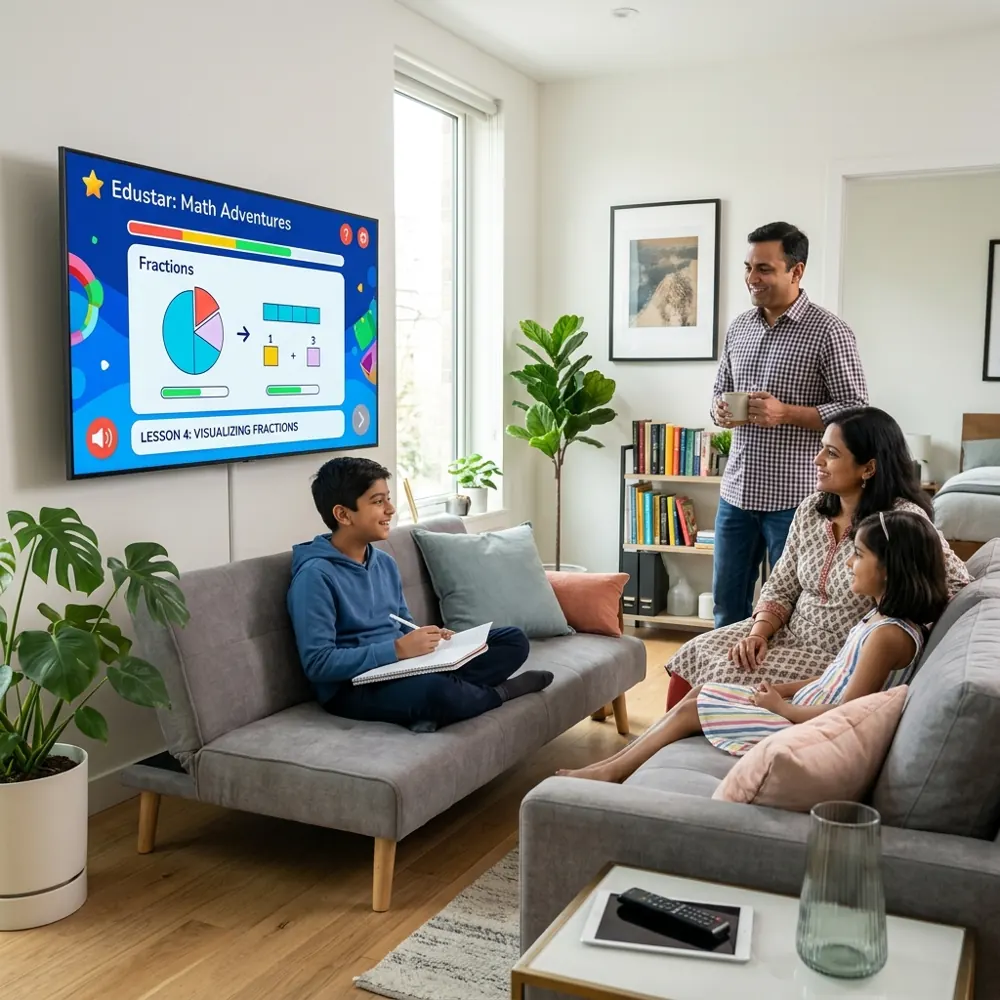
To combat this, visionary schools and coaching classes are shifting the educational paradigm. Instead of fighting the smartphone battle, they are changing the medium entirely. By bringing the School LMS Platform to the biggest screen in the houseβthe Android Smart TVβeducation is transformed.
VHM Academy is at the forefront of this revolution. Our proprietary Android TV Learning App is completely reshaping how students in Gujarat and across India consume educational content.
Visual Transparency
Parents can see exactly what the child is learning from across the room.
Ergonomic Posture
Sitting back on a sofa looking straight ahead prevents neck and back strain.
Zero Notifications
No pop-ups, no social media, no messaging apps to break concentration.
Family Engagement
Learning becomes a collaborative family experience rather than isolated screen time.
How VHM Academyβs TV Integration Works
Integration is seamless for institutions using the VHM Academy ecosystem. When teachers upload video lectures, 3D animated content, or PDF notes via their dashboard, the content instantly synchronizes across all student devices.
Interactive Features on the Big Screen
This isn't just passive video watching. The VHM Android TV app is highly interactive. Using a standard TV remote, students can:
- Navigate through their subject folders and daily assignments.
- Play, pause, and rewind complex educational videos.
- Take multiple-choice quizzes directly on the TV screen.
- View report cards, attendance records, and school circulars.
True Parental Control via the Parent Mobile App
The genius of the VHM ecosystem lies in the connection between the TV app and the Parent Mobile App. The TV acts as the learning conduit, while the parent's smartphone acts as the remote control and monitoring dashboard.
Through the parent app, mothers and fathers receive real-time analytics. They know exactly which video their child watched, for how many minutes, and how they scored on the remote-controlled quiz. If a student tries to exit the learning app to open YouTube on the smart TV, parents can be immediately notified through the Communication Suite.
Why Schools and Academies Must Adapt
For school owners and coaching institute administrators, offering Android TV learning is a massive competitive advantage. It demonstrates to parents that your institution cares deeply about their child's physical health, mental focus, and digital safety. When admission season arrives, a school that offers "Distraction-Free Living Room Learning" via VHM Academy will always stand out against a school that only offers a standard mobile app.
By investing in smart, interconnected technology, educational institutions can finally bridge the gap between digital convenience and focused academic rigor.